Article • 1 min read
The unified foundation: Preparing your contact center for agentic AI
Stop patching your legacy stack. A unified AI ecosystem is what your contact center needs to stay ahead.


Hannah Deveney
Senior Director, Product Management at Zendesk
Last updated April 8, 2026


It starts with the best of intentions. Your Workforce Management (WFM) team needs a more robust forecasting tool to handle holiday spikes or your support team requests a specific ticketing system.
But things have changed, and it is time to take another look at your architecture. What was once considered the “best-of-breed” is fast becoming a liability, as leading platforms now offer advanced capabilities natively built-in. If you’re still patching together systems, you may have inadvertently built a Frankenstein’s monster of disparate technologies. Instead of a high-performance customer experience (CX) engine, you have a collection of parts held together by the fragile custom APIs and third-party connectors.
While human agents can slowly bridge the gaps between fractured systems, AI cannot. We are now well and truly in the era of Agentic AI in the contact center, where AI agents can understand customer intent, follow policies, and take action autonomously. But you cannot layer advanced, Agentic AI on top of a broken foundation. To do more than answer basic FAQs, it requires a unified platform, not a patchwork of silos.
The hidden cost of the connectivity gap
For years, companies have fallen into the hyper-specialization trap, believing that buying the best individual tool for every specific task yields the best overall system. However, the reality is that value is generated by flow and interconnectivity, not just a tool’s standalone capability.
This accumulation of software creates severe operational bleed:
- The financial drain: You are not just paying multiple subscription fees. You are paying for the IT hours required to maintain brittle connections, and for the downtime when an update to one program breaks another.
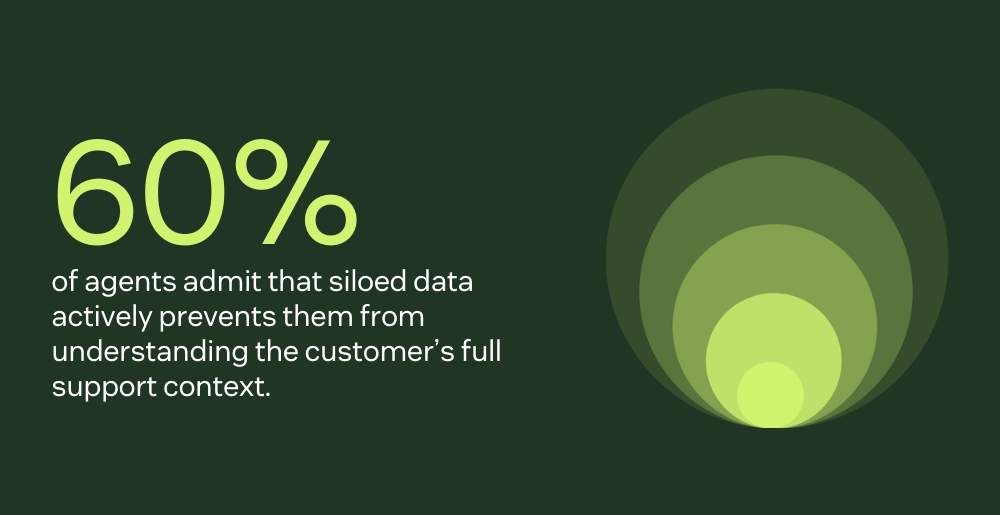
- The friction premium: Technical fragmentation generates friction that bleeds directly into the service experience. In fact the average worker switches between systems and screens nearly 1,200 times a day, costing businesses up to 9% of their employees’ annual working time in lost focus. When agents are forced to hunt across silos for answers, the customer pays the price. According to Zendesk’s CX Trends Report, while 70% of customers expect agents to have the full context of their situation, 60% of agents admit that siloed data actively prevents them from delivering it.
Why fragmented stacks limit agentic AI
When your ecosystem is fractured, the friction impacts your bottom line. AI agents that can’t resolve issues frustrate users, driving up customer churn. Here is why legacy stacks fail Agentic AI:
- The context blind spot: Agentic AI relies on a clean, unified data layer to make decisions. In a fragmented stack, data is trapped. An AI agent might see a support ticket but miss the critical context that the customer just purchased a specific promotion. The result is a low-IQ bot that talks to the customer with little personalization or context, leading to frustration and lost brand loyalty when they can’t achieve the resolution they need.
- The execution paralysis: Agentic AI needs to be able to take action: process a refund or reschedule a flight. If AI has to jump through fragile API hoops to write data back to a disparate system, the action is bound to fail.
The human impact: Swivel-chair fatigue
We often focus on the customer, but we cannot ignore the Agent Experience (AX). In a disconnected environment, a human agent is forced to toggle between four or five different windows just to resolve a single query.
This manual bridging of systems creates immense cognitive load, draining mental energy and driving burnout, contributing to higher agent turnover. No matter how fast an agent can toggle between screens, that disjointed experience comes with a tax. It interrupts workflow, breaks context, and ultimately, it takes the agent on average 23 minutes to regain focus. As a consequence, the customer suffers a disjointed journey. They feel the friction when they have to repeat their issue because context didn’t travel from the AI agent to the human agent.
The opportunity for platform-first architecture
To deploy agentic AI in the contact center, businesses must pivot toward a modern, unified platform. This requires a fundamental shift in architecture. A truly unified platform allows your systems, digital channels, and AI to interact natively. This slashes your IT maintenance costs and subscription fees, removes data siloes that interrupt AI flow and brings all tools into a single system for a seamless agent experience.
This is exactly why Zendesk Contact Center is built to eliminate the complexity that slows teams down. Instead of stitching together vendors, middleware, and point solutions, it brings voice, digital channels, and AI into one unified ecosystem on the Resolution Platform. Here’s how Zendesk is the most direct path to the agentic contact center:
- Cost savings through consolidation: Legacy systems introduce vendor risk and fragility. Zendesk gives you a complete contact center without the middleware cost, eliminating the single point of failure inherent in third-party systems. No extra vendors, no toggling between tools, and no lag.
- AI-powered orchestration: AI is built-in, not bolted-on. Zendesk embeds generative and agentic AI directly into workflows to automate tasks and guide agents, rather than duct-taping a third-party bot onto old tech.
- Accelerated ROI: Get live in weeks, not quarters with a lighting fast time to value. While competitors drag out complex deployments, Zendesk delivers enterprise-grade voice, smart IVR, and AI self-service right out of the box.
- High-quality, precision service: The control center ensures streamlined workflows and effortless support. Fewer tabs, smarter tools, and zero handoff drops mean faster resolutions for your customers.
Four steps to AI readiness
Transitioning to a unified platform requires deliberate action. Here is how to prepare your infrastructure:
- Audit the friction points: Start by mapping your customer journey and the back end systems within the contact center to identify exactly where data jumps and where context is lost. By mapping these technical disconnects, you can pinpoint the exact barriers preventing Agentic AI deployment, allowing you to clear the path for true autonomous action.
- Adopt a platform-first mindset: Stop buying niche tools that solve small problems but create macro-level headaches across your organization. Consider a system that removes the gaps between channels, agents, and systems so every interaction gets resolved faster.
- Unify the interface: Eliminate swivel-chair fatigue and dramatically reduce Average Handle Time (AHT) by consolidating all channels, data, and workflows into a single workspace for both human and AI agents.
- Deploy native intelligence: Ensure your AI agents have native access to your core systems rather than relying on brittle workarounds and third-party middleware. This deep, native integration is exactly what empowers your AI to drive end-to-end resolution, actually solving customer problems on its own.
From maintenance to agility
Adding a new tool often feels like progress, but in the age of Agentic AI, complexity is your greatest enemy. By moving away from fragmented systems, you stop paying for IT maintenance and start investing in agility.
A unified platform transforms your contact center from a traditional cost center into a dynamic, strategic asset. You gain the freedom to deploy new capabilities faster because you are no longer fighting your own infrastructure. The technology for true AI transformation is already here, don’t let your legacy stack limit your contact center’s potential.
Only Zendesk gives you a complete contact center that helps you deliver AI-first experiences. In one, unified platform, it provides voice, messaging, AI agents and WFM seamlessly integrated with no extra vendors or added complexity.


