Agentic AI autonomously plans, reasons, and acts to resolve complex service tasks. Learn how it works, its key features, benefits, and real-world use cases.
Last updated 14 April 2026
What is agentic AI?
Agentic AI is an autonomous AI system that independently plans, reasons, and executes multi-step tasks to achieve a specific goal with minimal human supervision. Unlike reactive AI models that wait for explicit instructions, agentic AI understands its environment, constructs action plans, and adapts based on outcomes. This makes it capable of resolving complex service scenarios end-to-end. Its defining characteristic is self-directed action: it determines what to do next based on objectives and available context, rather than following rigid, pre-programmed rules.
Agentic AI is rapidly shifting from a buzzword to a practical cornerstone of modern customer and employee service. It functions less like a search bar and more like a highly capable, self-directed teammate who can handle complex, multi-step service tasks around the clock.
For service leaders, the implications are significant. According to the 2026 Zendesk CX trends report, “81% believe that empowering any employee to ask data questions in plain language closes a huge skill gap”. This guide explores everything you need to know about agentic AI, including its key features, benefits, and ways to integrate it into your organization.
Agentic AI vs. generative AI: What’s the difference?
Generative AI and agentic AI are related but serve fundamentally different purposes. Generative AI—the technology behind tools like ChatGPT—is designed to produce content: text, images, code, or summaries in response to a prompt. It excels at creation and explanation, but it waits to be asked and stops once it has responded.
Agentic AI goes further. It uses generative AI as one of its underlying capabilities, but wraps it in a goal-oriented decision-making framework. Rather than just answering a question, agentic AI determines what actions to take, executes them across multiple tools and systems, checks outcomes, and adjusts autonomously. Think of generative AI as the voice and agentic AI as the hands and brain working together to get a job done.
For example, In a service context, a generative AI model might draft a response to a customer complaint. On the other hand, an agentic AI system would read the complaint, look up the customer’s order history, issue a refund, update the CRM record, and send a personalized follow-up, without a human initiating each step.
How agentic AI works
Agentic AI operates through a continuous cycle of four phases that allow it to handle complex, multi-step service tasks at a speed and scale impossible for human teams alone.
Understanding
Agentic AI continuously monitors data streams like customer communications, ticket history, behaviour patterns, and system status, to identify areas needing attention. It doesn’t wait to be told there’s a problem; it actively scans for signals that indicate one.
Evaluation
Rather than following a decision tree, agentic AI evaluates context, weighs possible outcomes, and constructs an action plan. For example, when a billing discrepancy appears, it reviews account history, policy constraints, and resolution options before choosing the best path.
Action
Agentic AI executes actions across connected systems: routing tickets, triggering workflows, or escalating to a human agent when the situation warrants it. It acts with the full context of what it has understood and reasoned.
Learning
Every resolved interaction feeds back into the system, refining how agentic AI handles similar scenarios in the future. This learning loop means the system becomes more accurate and efficient over time, without requiring manual re-training for each edge case.
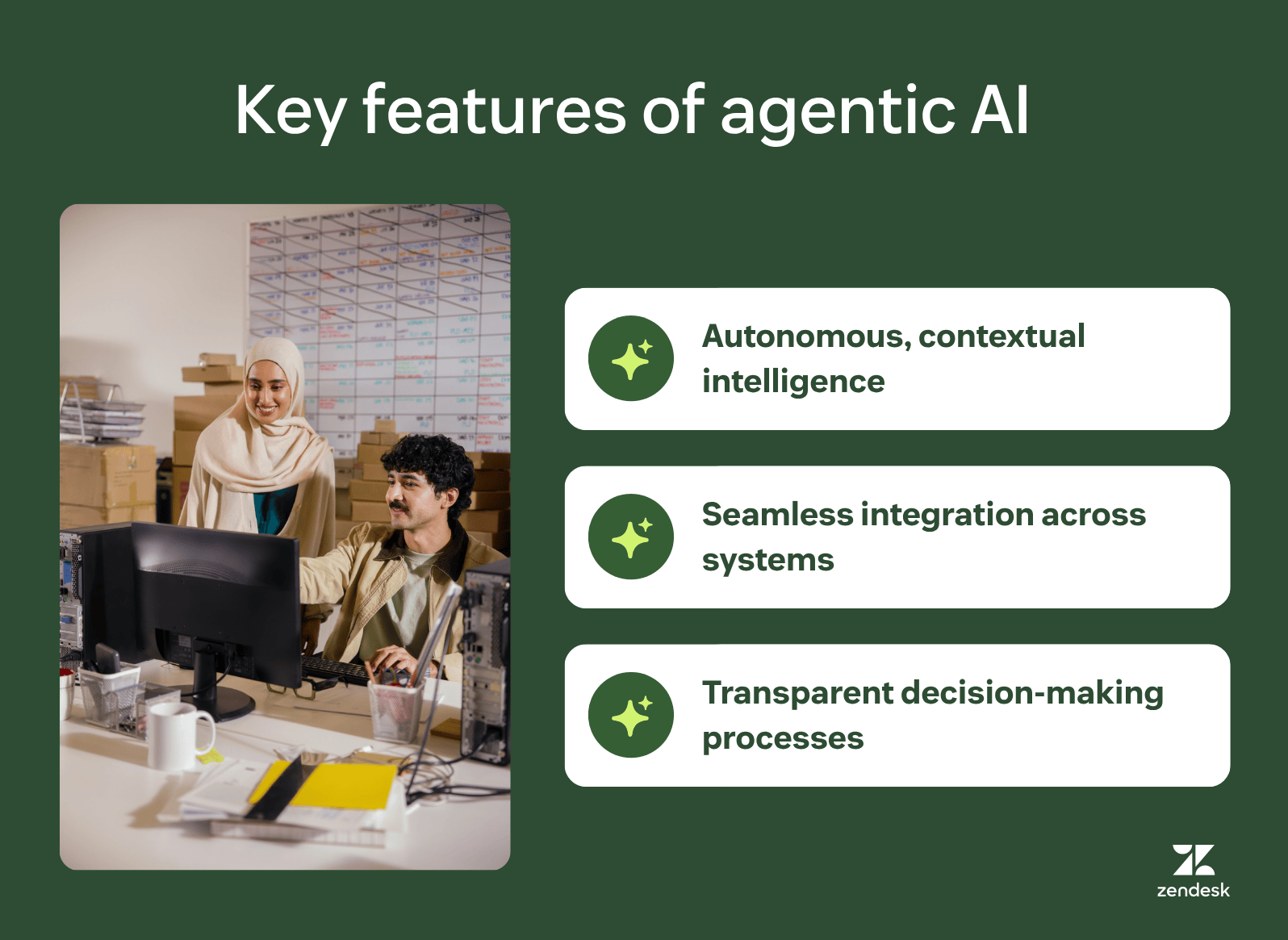
Key features of agentic AI
Agentic AI’s power comes from a combination of capabilities that enable truly autonomous service delivery, while keeping humans informed and in control at every step.
Autonomous, contextual intelligence
New: Unlike rule-based systems that operate with rigid guidelines, agentic AI demonstrates flexible reasoning. It dynamically weighs multiple factors to make nuanced decisions that adapt to each unique service situation. These factors include:
Employee role hierarchies
Historical interaction patterns
Urgency indicators
Organizational policies
Real-time system data
This flexibility extends to agentic AI’s communication style, which adjusts based on the recipient’s preferences and sentiment, ensuring every interaction feels personalized rather than automated.
Some advanced AI tools, like Zendesk, have AI-powered quality assurance (QA) solutions. These tools bridge your service channels by analysing 100 percent of interactions (including voice and live chat) for unparalleled context and consistency.
Seamless integration across systems
Agentic AI connects with existing CRM platforms, knowledge bases, HR systems, scheduling tools, and communication channels like Slack and Microsoft Teams — creating a unified service ecosystem where information flows automatically between systems. Modern agentic platforms are specifically designed to layer on top of existing stacks, turning them from passive ticket repositories into active resolution engines. This means organizations don’t need to replace their current infrastructure to benefit from agentic AI; the system amplifies what’s already in place.
Transparent decision-making processes
Agentic AI shows its reasoning in real time, displaying why it took a specific action, what data it used, and how confident it was. Service teams can review reasoning chains, adjust parameters, and set approval thresholds for specific action types. This transparency is not just about trust, it’s also about governance. Teams can intervene, override, or refine AI behaviour without waiting for an engineering change, ensuring the system stays aligned with evolving business needs and compliance requirements.
Agentic AI benefits
The real power of agentic AI lies in its ability to elevate service quality while improving operational efficiency and employee satisfaction. Here are five key benefits of using agentic AI.
Maximizes personalization
Agentic AI pushes personalization further than other problem-solving AI tools. These systems create a detailed understanding of individual preferences and needs by analysing vast amounts of interaction history, behavioural patterns, and contextual cues. This goes beyond simple demographic targeting to include:
Communication style preferences
Problem-solving approaches
Optimal timing for different types of interactions
The resulting service experiences feel genuinely tailored to each person. This level of personalization builds stronger relationships and increases satisfaction on both sides of the service equation.
Automates complex problem-solving
Traditional automation handles simple, predictable tasks. Agentic AI tackles multi-step, context-dependent scenarios that previously required experienced human agents. For example, processing a billing dispute that spans three systems, or coordinating a new employee’s onboarding access across platforms. This frees human agents to focus on the high-judgment conversations where their skills matter most.
Reduces resolution time
Agentic AI acts autonomously across connected systems, without waiting for a human to read, interpret, and respond to each step. As a result, resolution times drop dramatically. Routine tickets that previously required 30 minutes of back-and-forth can be resolved in seconds. This speed improvement compounds across high-volume service operations, translating directly into lower cost per ticket and higher throughput.
Improves agent satisfaction and retention
Agent burnout is a significant driver of turnover in service organizations. Agentic AI absorbs the high-volume, low-complexity work that drains energy, leaving human agents with a more engaging, meaningful workload.
Delivers consistent service quality
Human agents have good days and difficult days; agentic AI does not. It applies the same reasoning, the same policies, and the same quality standard to every interaction. For organizations where inconsistency is a known pain point, agentic AI provides reliable quality that human agents can then exceed, rather than having to compensate for.
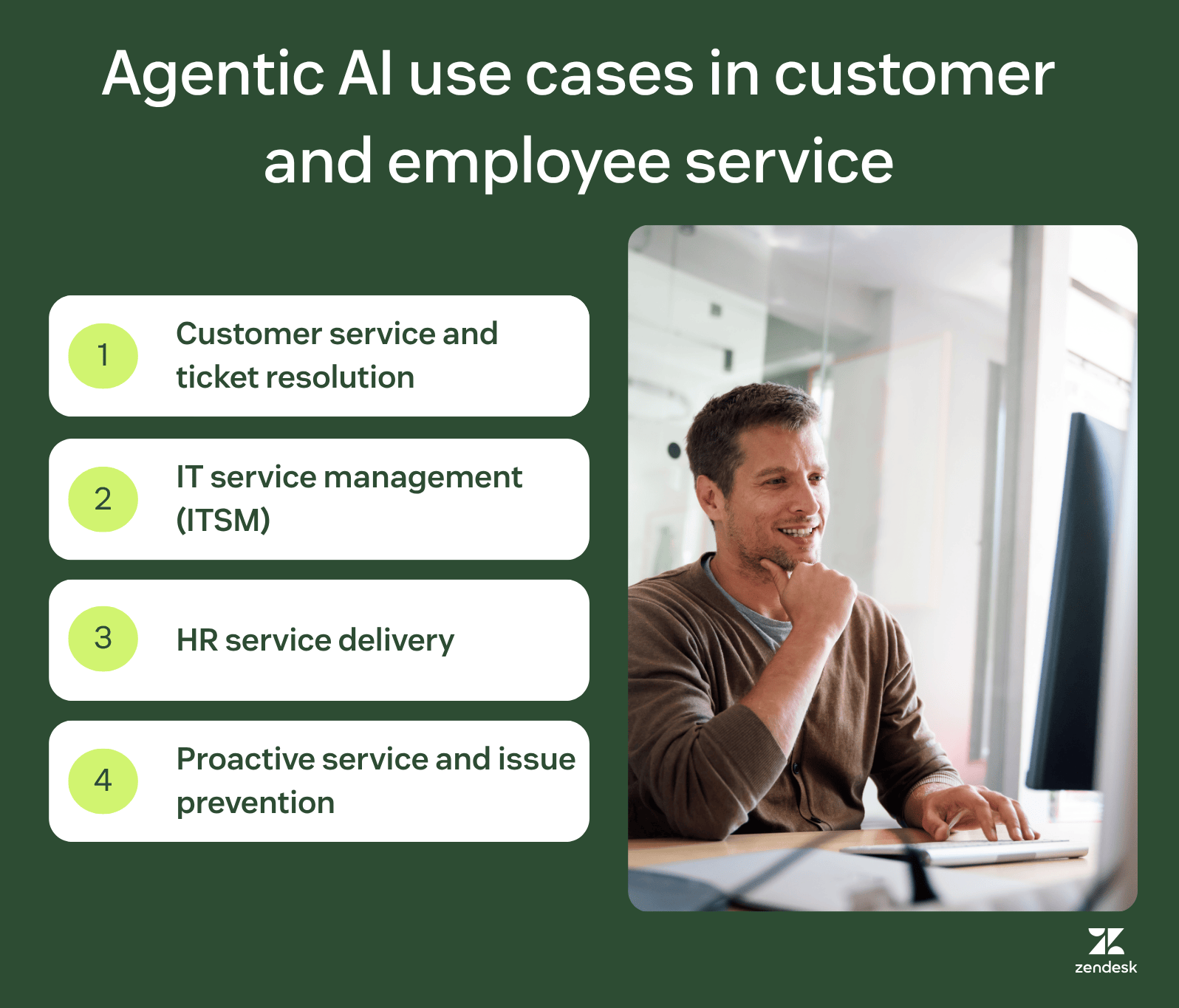
Agentic AI use cases in customer and employee service
Agentic AI is being implemented across the full spectrum of service interactions, from customer-facing support to internal IT and HR operations. Here are the highest-impact use cases organizations are deploying today.
Customer service and ticket resolution
Agentic AI autonomously handles customer inquiries end-to-end, from reading and categorizing an inbound ticket to closing it. For e-commerce brands, this covers order status, returns, subscription changes, and billing disputes. For SaaS companies, it covers account access, billing, and feature questions. The system escalates to a human agent only when the situation requires genuine judgment or empathy.
IT service management (ITSM)
In IT environments, agentic AI monitors systems for anomalies, auto-classifies and routes incidents, triggers remediation workflows, and communicates status updates to affected users—all without manual triage. For instance, it can cross-reference onboarding checklists with active directory permissions to catch provisioning gaps before a new employee’s first day.
HR service delivery
Agentic AI handles high-volume HR inquiries like benefits questions, policy lookups, leave requests, or payroll discrepancies. It retrieves the right information from knowledge bases and HR systems and delivers a complete, accurate answer without routing to an HR specialist. For complex cases, it prepares a full context summary for the HR team, reducing handling time significantly and allowing specialists to focus on strategic work.
Proactive service and issue prevention
Rather than waiting for a customer or employee to submit a ticket, agentic AI can identify signals that predict a problem and act before it escalates. For example, if a customer’s usage pattern suggests they are about to churn, or an employee’s access credentials are due to expire, the system can proactively reach out with a resolution. This preemptive technology converts a potential service failure into a positive experience.
Future agentic AI trends and predictions
Agentic AI is evolving rapidly. The capabilities available today represent the foundation of a much broader transformation in how service will be delivered.
Multi-agent orchestration
The next frontier of agentic AI is not a single autonomous agent but a coordinated network of specialized agents working together. One handles triage, another manages system lookups, and another drafts communications. Multi-agent systems are already emerging in enterprise environments and will become the standard architecture for complex service automation within the next few years.
Deeper integration with voice and omnichannel
Agentic AI is expanding beyond text-based channels into voice interactions, enabling fully autonomous phone-based service resolution. As omnichannel context becomes richer (combining chat, email, voice, and in-app signals), agentic AI will be able to carry a continuous understanding of each customer across every touchpoint.
Governance and trust frameworks
As agentic AI takes on higher-stakes decisions, the framework for governing its behaviour will become a core enterprise requirement. Organizations that invest in AI governance now will be better positioned to scale agentic capabilities safely and maintain regulatory compliance as the technology matures.
‘Agentic’ describes the capacity to act independently toward a goal. Agentic AI doesn’t just respond to prompts—it understands context, forms plans, executes multi-step actions, and adapts based on outcomes.
Agentic AI isn’t exactly the same as an AI agent. AI agents use agentic AI to act autonomously within a defined scope. Agentic AI is the broader capability that enables AI agents to perceive, reason, act, and learn independently.
No, agentic AI is designed to augment human agents, not replace them. It handles high-volume, repeatable tasks autonomously, freeing human agents to focus on complex, empathy-driven conversations. The most effective deployments treat agentic AI as a teammate that removes friction, not headcount.
Agentic AI is only as effective as the knowledge base and data it can access; poor or outdated information leads to inaccurate resolutions. It also requires clear guardrails for edge cases and high-stakes decisions. Starting with a phased rollout for well-defined, high-confidence ticket types and investing in knowledge base quality are the most reliable ways to mitigate these limitations.
Implementation timelines vary by scope, but teams that start with a focused set of high-volume, well-defined use cases can see measurable results within weeks. Full enterprise rollouts with deep system integrations typically take several months and benefit from dedicated internal ownership of the AI configuration and knowledge base.
Unlock smarter and more autonomous service with agentic AI
The future of employee service solutions is an even stronger partnership between human expertise and AI, where technology enhances human capabilities and maintains empathy for exceptional service. Agentic AI represents this evolution – intelligent systems that don’t just automate tasks but actively contribute to strategic service improvement.
The question isn’t whether agentic AI will transform service delivery but how quickly organizations can adapt to harness its potential for creating truly exceptional service experiences. With Zendesk, you get an out-of-the-box, AI-powered solution that’s pre-trained on billions of real service interactions and gets better with each new ticket it handles. Try it for free and experience the power of agentic AI for yourself.
Frequently asked questions
Gen AI (or generative AI) creates content based on prompts and training data, essentially functioning as an advanced content creation tool. Agentic AI goes beyond content generation to autonomous decision-making and action-taking. It plans multi-step processes and adapts strategies based on outcomes.
While generative AI might write a response to a customer enquiry, agentic AI would analyse the customer's situation, determine the best resolution approach, coordinate necessary actions across multiple systems, and follow up to ensure satisfaction.
An agentic AI system is a comprehensive software solution that combines autonomous decision-making capabilities with integration across multiple business systems and workflows. Unlike standalone AI tools, these systems operate as intelligent all-in-one solutions that can perceive situations, reason through complex scenarios, take appropriate actions, and learn from outcomes.
Unlock smarter and more autonomous service with agentic AI
The future of employee service solutions is an even stronger partnership between human expertise and AI, where technology enhances human capabilities and maintains empathy for exceptional service. Agentic AI represents this evolution – intelligent systems that don't just automate tasks but actively contribute to strategic service improvement.
The question isn't whether agentic AI will transform service delivery but how schnell organisations can adapt to harness its potential for creating truly exceptional service experiences. With Zendesk, you get an out-of-the-box, AI-powered solution that's pre-trained on billions of real service interactions and gets better with each new ticket it handles. Try it for free and experience the power of agentic AI for yourself.
Try leading agentic AI for free
Zendesk AI agents are trained on billions of real service interactions—see for yourself.